


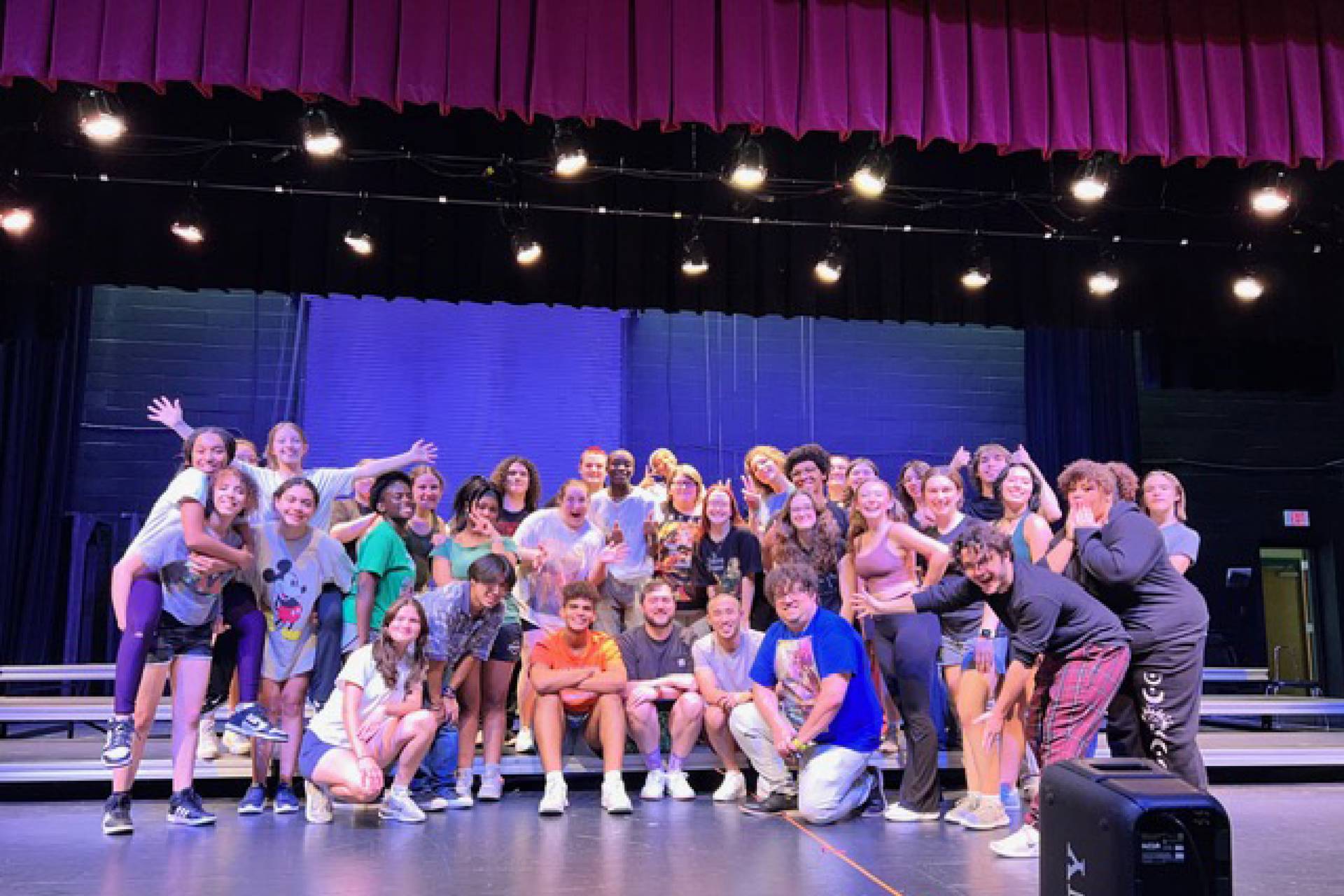
When current director James Miller arrived in 2018, he began to rebuild the program by showing students what show choir looked like beyond state lines—and the more they saw, the more committed they became to reaching a higher tier.
Setting the bar higher than they ever had before, Kaleidoscope was named Grand Champions at the Alliance Royal Aviation Show Choir Competition in February of 2023, just a few years into Miller’s tenure as director. In 2025, they competed at Show Choir Nationals in Nashville as only the third West Virginia School invited to attend in the event’s history.
The program experienced another boost when Miller recruited Isaac Mei, a show choir veteran with nearly 20 years of choreography and vocal experience who had worked with groups from Maryland to Mississippi. Having briefly retired from choreographing, Mei started a show choir podcast and eventually landed on Miller’s radar. Sensing in him a kindred spirit, Miller hired Mei prior to starting the 2023 competition season as a choreographer and assistant director.
Mei admired what Miller had already accomplished at Musselman. “James had really brought his creativity and put a new spin on things, and it brought a new culture to Kaleidoscope,” Mei says. “I was able to come in and help accelerate that process.”
Memorable Shows
Though the program has now won awards such as Best Vocals, Best Choreography and Best Band at multiple competitions and competed at Show Choir Nationals—held at Nashville’s famed Grand Ole Opry—it’s still relatively new to competition-level performance, on top of which much of Miller’s early efforts were lost to the COVID years. For now, Miller isn’t focused so much on scores and placement as energy and entertainment.
“I don’t necessarily do something that says, ‘Oh this is going to get us points for the judges,’ he says. “For me, every show has a piece of my creative mind on the stage, and I can explore it with people who are going to help me create the art on stage, because I want the audience to be hooked from the jump. By the time they leave the auditorium, I want them to say ‘Wow, I was completely entertained, that got me to the edge of my seat.’”
Mei, who has a master’s degree in Marketing, says that speaks to his own goals for Kaleidoscope. “As a marketer you want to find your niche as a brand,” he says. “We know the program is continuing to develop in the fundamentals, but even if we’re not already there yet, we can still be entertaining. That’s how I approach my job as a choreographer.”
Miller says that coming up with new ideas—and always including at least one song the audience will recognize (“and there will always be a rock song; that’s part of who I am”) helps build the momentum. “What can I do to get the kids really believing in show choir? I find unique ideas—we’ve done a Mario show; we’ve done “Avatar: The Last Airbender”—so people associate our choir with doing something they’re going to remember. This season’s show is an adaptation from the classic “Batman” comic-book stories.
Come One, Come All
Miller and Mei say convincing the school, boosters, and parents it’s worth the financial investment is a challenge for any program, and any director will tell you they can always use more talent. That’s truer at Musselman than other schools; as long as they’re still a growing program, it’s less about picking and choosing at audition time and more about making it possible for everyone who tries out to join the choir and thrive.
Mei says he was surprised to learn Kaleidoscope has mostly a come one, come all audition process. “I had never been part of a group that didn’t cut students,” he says. “But if they can prove in auditions that they have a base level of competency—and the passion and reason to be there—we’re going to coach them up to give the best performance possible. If they can bring the energy to the stage, the crowd will feel that.”
Adds Miller: “That’s the biggest achievement we have, that we take people who might get cut from other groups, and while some of them start the year by trying to hide from everybody, by the end of the year they’re dancing in the front row. It’s beautiful to see the progression.”