


The first is when the concept is unveiled.
Everyone gathers around the design sketches. The excitement is contagious. Students are amazed. Choreographers are inspired. Parents are impressed. The booster president nervously asks, “How much is this going to cost?”
The second moment occurs at 5:15 a.m. on a competition morning when someone is attempting to fit a 12-foot set piece through a trailer door that is clearly only 10 feet tall.
That is the moment reality enters the conversation.
Over the years, I’ve learned that designing sets for show choir is equal parts creativity, engineering, logistics, psychology, and occasionally emergency carpentry.
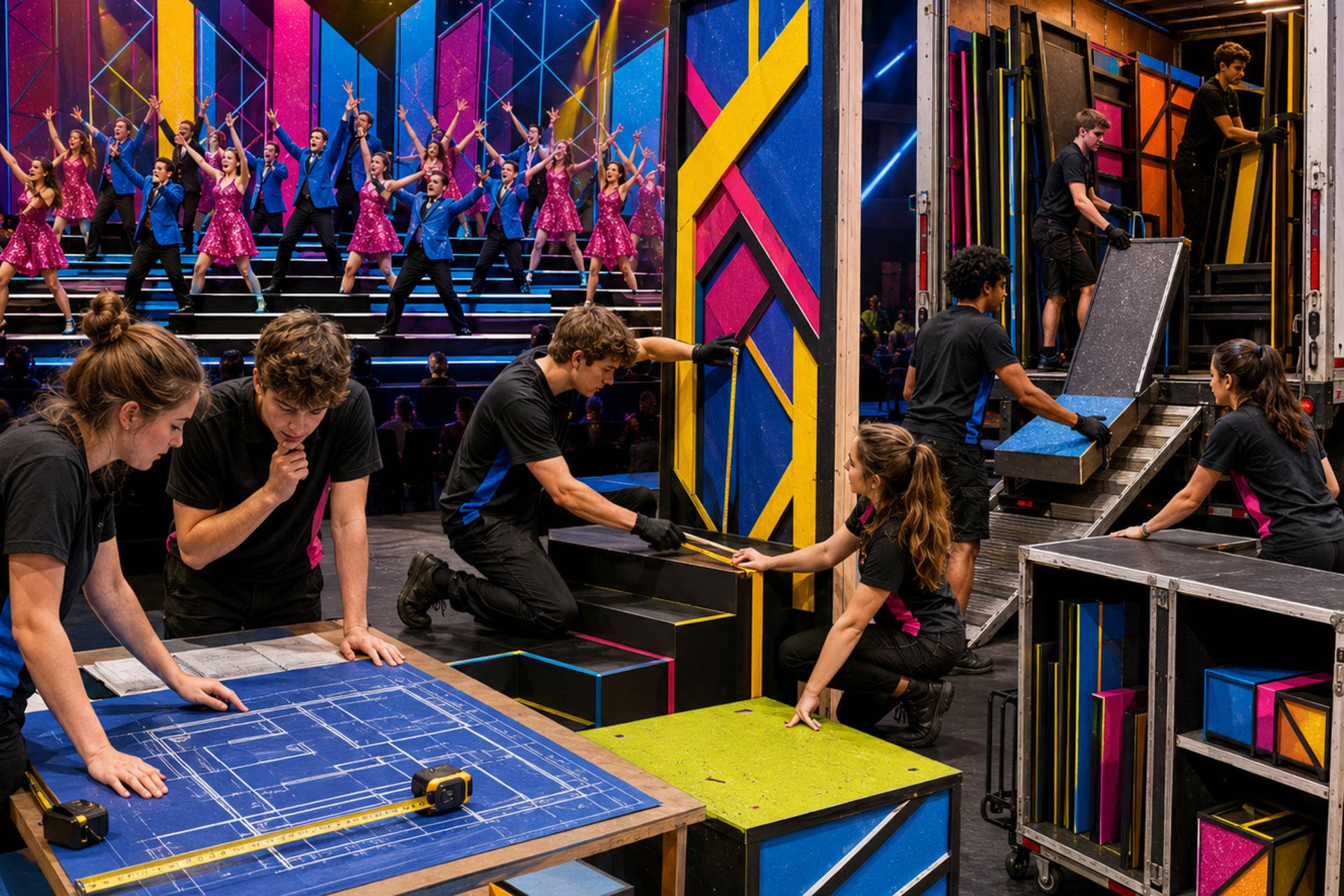
I’ve also learned that the most beautiful set in the world becomes completely useless if you can’t get it into the performance venue, set it up in under two minutes, and remove it without causing a small traffic incident backstage.
Some of those lessons were learned the easy way.
Many were not.
The Year We Built a Masterpiece
Several years ago, our design team developed what we believed was the greatest set concept in show choir history.
It featured multiple levels, dramatic visual elements, moving pieces, and enough architectural detail to make a Broadway scenic designer smile.
On paper, it was magnificent.
In the workshop, it looked incredible.
Then we loaded it into the trailer.
Or at least we tried to.
What nobody had fully considered was that while each section technically fit inside the trailer, they fit together like a giant three-dimensional puzzle designed by someone who hated transportation directors.
Loading took nearly two hours.
Unloading wasn’t much better.
By mid-season, every member of our tech crew had developed a look that suggested they were reconsidering their life choices.
The lesson was simple:
If portability isn’t part of the design process, the design process isn’t finished.
Portability Is Not a Bonus Feature
Many directors begin with one question:
“What would look amazing?”
The better question is:
“What would look amazing and survive ten weekends of travel?”
Show choir sets are not static stage scenery.
They’re traveling scenery.
That distinction matters.
Every competition requires:
Loading
Transporting
Unloading
Assembly
Performance
Disassembly
Reloading
Then you do it again next weekend.
And the weekend after that.
And the weekend after that.
Portability should influence every design decision.
Can it break down?
Can one person carry it?
Can students move it safely?
Will it fit through standard doors?
Can it survive being loaded at six in the morning by people who have consumed only coffee and optimism?
These questions are not glamorous.
But they are important.
The “One-Hand Test”
One of my favorite unofficial design standards is what I call the One-Hand Test.
Can a reasonably responsible teenager carry part of the set with one hand?
If the answer is no, we may need to rethink the design.
This doesn’t mean every piece must be lightweight.
It means the set should be designed with transportation and setup in mind.
Every pound matters.
Every extra trip to the trailer matters.
Every complicated assembly process matters.
Especially at competitions.
The Great Reuse Debate
Every year, directors face a familiar question.
Can we use something from last year’s show?
The answer is both yes and no.
Helpful, right?
Reusing set pieces can be one of the smartest financial decisions a program makes.
It can also become a creative trap.
Let’s start with the advantages.
Why Reusing Sets Makes Sense
The most obvious benefit is cost.
Lumber isn’t getting cheaper.
Hardware isn’t getting cheaper.
Paint isn’t getting cheaper.
If you already own quality scenic pieces, there is no reason to ignore them.
I’ve seen directors transform old platforms, arches, stair units, and scenic walls into entirely new concepts.
A fresh coat of paint and creative redesign can make familiar pieces feel brand new.
The audience doesn’t know that castle wall used to be part of a city skyline.
They just know it looks good.
Storage space is also valuable.
Programs that reuse elements often maximize investments made over multiple seasons.
Smart programs build scenic inventories rather than entirely new productions every year.
The Risks of Reusing Too Much
The downside is creative fatigue.
Students notice.
Parents notice.
Judges sometimes notice.
Nothing kills excitement faster than hearing:
“Wait… isn’t that the same thing we used last year?”
Show choir thrives on innovation.
Every season should feel unique.
The challenge is finding the balance between financial responsibility and artistic freshness.
Sometimes reusing the framework while changing the visual treatment provides the perfect solution.
The bones remain the same.
The audience experiences something entirely new.
Competitions Are Not in Your Auditorium
One of the biggest mistakes directors make is designing sets specifically for their home stage.
The competition circuit operates under a completely different set of realities.
Your beautiful auditorium may have:
Large wings
Ample storage
Generous backstage space
Convenient loading access
Competition venues often have none of those things.
I once attended an event where backstage space was approximately the size of a walk-in closet.
Every participating group was attempting to store scenery, props, costumes, and equipment in the same area.
It looked like a garage sale hosted by Broadway.
The programs that succeeded were the ones whose sets were designed for efficiency.
The programs that struggled were the ones whose scenery demanded excessive space.
Design for the venue you’ll visit most often—not the one you rehearse in every day.
Your Tech Crew Is Not a Construction Company
Perhaps the most important lesson I’ve learned is this:
Design for the people who will actually move the set.
This sounds obvious.
It isn’t.
Many scenic concepts are developed by adults standing comfortably around a conference table.
The actual setup is performed by students carrying equipment through crowded hallways while navigating schedules measured in seconds.
The tech crew should always have a voice in the design process.
Ask them:
What worked last year?
What slowed setup?
What caused problems?
What was difficult to transport?
They know things.
Important things.
Painful things.
Listen to them.
One year, a student tech leader pointed out that a particular scenic unit required six people to assemble because of an awkward connection point.
The design team initially dismissed the concern.
By the third competition, everyone realized the student was absolutely correct.
The unit was redesigned.
Setup time immediately improved.
Sometimes experience speaks louder than sketches.
The Two-Minute Rule
Many competitions provide limited setup time.
Very limited setup time.
In some situations, every second counts.
When evaluating a design, I often ask:
Can this be assembled quickly under pressure?
If a scenic element requires a detailed instruction manual, three specialty tools, and an engineering degree, it may not be competition-friendly.
The best competition sets often appear more complex than they actually are.
They are intentionally designed for speed.
Simple connections.
Clearly labeled sections.
Minimal assembly.
Maximum visual impact.
That’s the sweet spot.
Build It or Buy It?
This is one of the biggest decisions facing programs today.
Should you build your set or purchase one?
The answer depends on several factors.
Reasons to Build
Building offers flexibility.
You control:
Design
Materials
Dimensions
Functionality
Budget
Programs with strong booster support and skilled volunteers can create incredible scenery at relatively low cost.
There is also tremendous pride in performing with something your community built.
Students often feel a deeper connection to the production.
Reasons to Buy
Purchased scenic elements offer consistency.
Professional fabrication often provides:
Better durability
Cleaner finishes
Reduced labor
Faster completion
For programs lacking construction resources, purchasing may actually save money in the long run.
The key is evaluating the true cost.
Not just dollars.
Time.
Volunteer hours.
Storage.
Maintenance.
Stress.
Those things have value too.
The Hardware Store Hall of Fame
Every experienced set designer has a collection of stories involving last-minute hardware store runs.
I certainly do.
One memorable season involved a scenic element that repeatedly lost the same bolt during transportation.
Every weekend.
The same bolt.
Every time.
We eventually started carrying an entire bag of replacements.
Another year, a caster wheel failed halfway through loading.
Picture twenty students, three adults, one trailer, and a scenic wall that suddenly refused to move.
The wheel chose retirement at the least convenient moment imaginable.
We laugh about it now.
At the time, the vocabulary was considerably more colorful.
Those experiences taught an important lesson:
Always bring spare hardware.
Always.
Trust me.
Design for Success
The best show choir sets accomplish several things simultaneously.
They support the story.
They enhance visual impact.
They travel efficiently.
They respect the tech crew.
They fit the budget.
And perhaps most importantly, they disappear when necessary.
Great scenic design should elevate the performers rather than compete with them.
The audience should remember the show.
Not just the scenery.
Final Thoughts from the Trailer
After years of designing, building, loading, unloading, repainting, repairing, and occasionally apologizing for set-related disasters, I’ve come to appreciate one simple truth:
Good set design begins long before the first board is cut.
It begins with understanding how the set will live throughout an entire season.
Where it will travel.
Who will move it.
How quickly it must be assembled.
What resources are available.
And whether it can survive repeated encounters with parking lots, loading ramps, trailers, and exhausted teenagers.
The most successful show choir sets aren’t always the biggest.
They aren’t always the most expensive.
And they certainly aren’t always the most complicated.
They’re the ones that work.
Weekend after weekend.
Competition after competition.
Season after season.
Because at the end of the day, the goal isn’t simply to build something impressive.
The goal is to create a visual environment that allows students to shine.
And if you can accomplish that without anyone getting trapped behind a scenic wall in a loading dock at six in the morning, consider it a successful season.