


It may take too long to put on. It may restrict movement. It may photograph beautifully but disappear under stage lighting. It may require six snaps, three hooks and a zipper to remove. Or it may have so many accessories that the backstage crew needs a flowchart to get everyone changed before the next number.
When logistics take over, the story gets lost.
The best costume is the one that works in every way for your production. When your performer emerges in it at just the right moment, suddenly the audience understands something about the character, the setting, the emotion or the transformation taking place on stage—sometimes before a single word is sung.
That is the power of thoughtful costuming.
Start With the Story, Not the Costume
One of the biggest mistakes a show choir can make is falling in love with a costume before deciding what the costume needs to accomplish.
The process should begin with the production.
What is the story?
What characters or worlds are being introduced?
What changes during the show?
What is the emotional journey?
Once those questions have been answered, costumes become another storytelling tool.
Color can establish mood. Silhouette can establish time period. Texture can establish character. Accessories can identify a role or group. A change from muted colors to brighter colors can communicate transformation without the audience needing to be told what is happening.
A costume should have a reason to be there.
Costumes Create Visual Continuity
A show choir production can contain several musical styles, but the audience still needs to feel that they are watching one production.
Costumes can help create that continuity.
Perhaps the opening number establishes a basic color palette. A later number introduces a new layer. Another number removes that layer and reveals something completely different underneath.
The costumes do not necessarily have to match from song to song. In fact, they often shouldn’t.
They do, however, need to belong to the same visual world.
This is where color becomes particularly important.
A production can use one dominant color throughout while changing the silhouette and texture. It can use complementary colors to divide groups. It can move from dark to light as the story develops.
The important thing is that the costume changes communicate something.
What Judges Actually See
Competition costuming can be confusing because there is no single universal show choir score sheet.
Some competitions incorporate visual production, show production, overall impression, or similar categories. Others may have more specific visual or costume considerations. FAME, for example, describes its adjudication structure around vocal production, visual production, show production, and music production.
That distinction matters.
A director or booster should not assume that a judge simply awards a certain number of points because a costume is attractive.
Instead, think about what the costume contributes to the total performance.
Does it support the concept?
Does it enhance visual production?
Does it complement choreography?
Does it help establish character?
Does it create clean, unified stage pictures?
Does it distract from the performers?
Does it function reliably?
These are the questions that matter.
Competition judging varies considerably from one event to another, and experienced directors know that the same costume might be addressed under different categories on different score sheets. Research into show choir adjudication has also found that scoring practices and rubrics vary across competitions, reinforcing the importance of understanding the specific competition’s criteria rather than assuming every event judges costumes the same way.
The Difference Between Pretty and Effective
Remember: the costume serves the show, not the other way around.
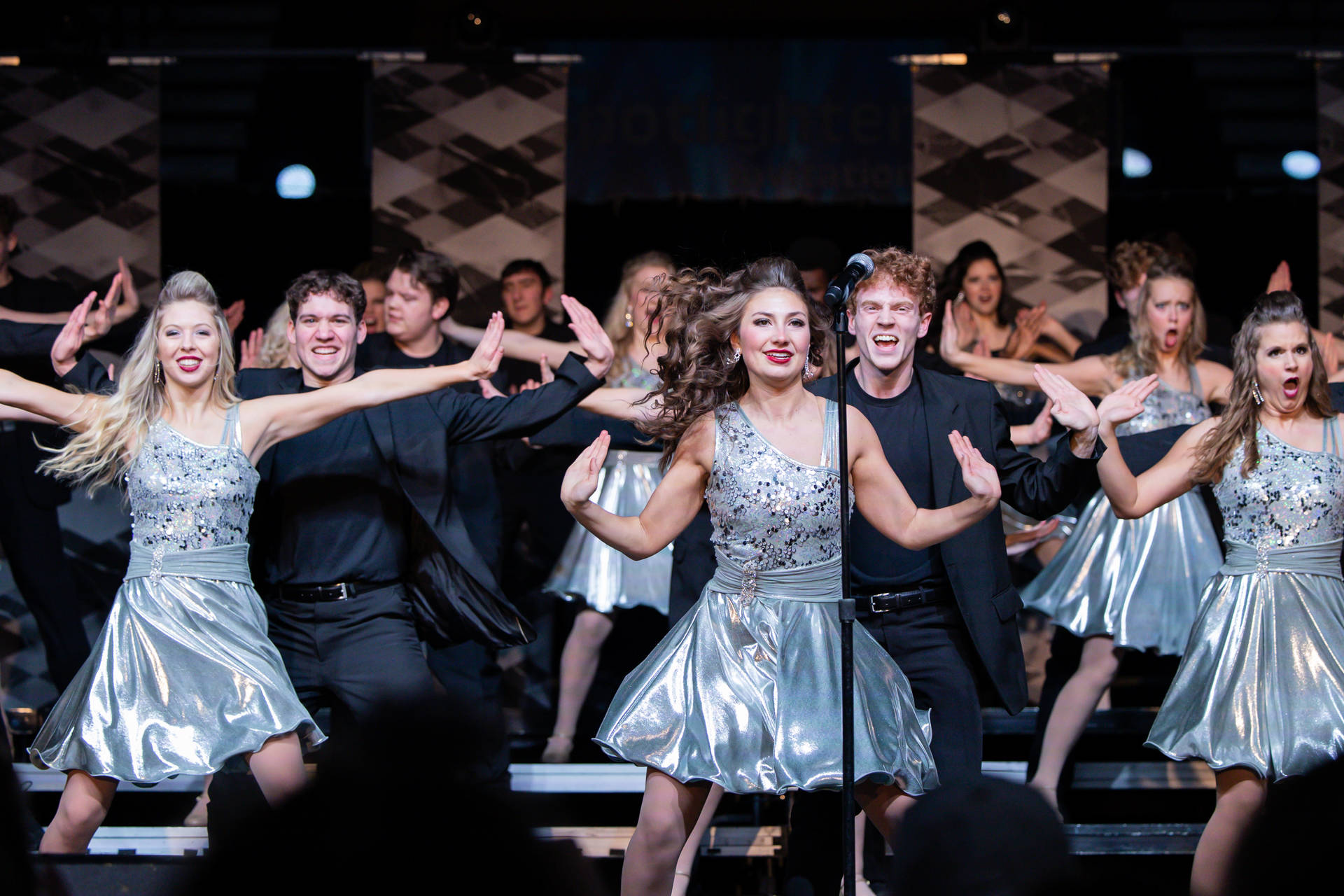
Imagine a ballad about loss performed in elaborate, sparkling costumes that compete with the emotion of the music. Or imagine a high-energy dance number performed in heavy garments that restrict movement.
The costume may be attractive.
It simply is not helping the story.
The strongest costume designs are not necessarily the most expensive or elaborate. They are the ones that make sense.
That is an important lesson for booster organizations working within a budget.
A $200 costume that works beautifully for the production is a better investment than a $500 costume that looks spectacular in a photograph but fails on stage.
Test the Costume Under Stage Conditions
Costumes should be evaluated under actual performance conditions.
Stage lighting can change everything.
Colors that look distinct in a fitting room can blend together under certain lights. Black can lose detail. Metallics can become extremely bright. Certain fabrics may reflect light in unexpected ways.
Movement changes the picture, too.
Have students perform choreography in the costume before the final decision is made.
Watch from the audience.
Look for hems, straps, waistbands and accessories that shift.
Watch what happens when performers jump, turn, kneel or lift their arms.
If the costume becomes a distraction during rehearsal, it will become a bigger distraction under competition pressure.
The Quick Change Is a Production Number
This is where seasoned show choir boosters tend to become very serious.
A quick change is not a costume change.
It is a choreographed backstage operation.
The students have to know exactly what comes off, what goes on, where each piece goes, and who is helping whom. The costume crew has to know where every garment and accessory is located. The performers have to be able to make the change under pressure.
And everyone needs to know what happens when something goes wrong.
Because eventually, something will go wrong.
A zipper will catch.
A snap will refuse to cooperate.
An earring will disappear.
A shoe will be in the wrong bag.
Someone will walk into the wings with the wrong jacket.
The best quick-change systems are designed with those possibilities in mind.
Design for Speed from the Beginning
Quick changes should be considered before the costume is purchased.
Ask:
Can the garment be removed quickly?
Can it be put on without assistance?
Are closures easy to operate?
Can students identify the front and back immediately?
Can the costume be layered?
Can an accessory create the appearance of a completely new costume?
Can a jacket, skirt, vest or overskirt transform the look without requiring a full change?
Layering is one of the smartest tools available to show choir programs.
A basic foundation costume can become a completely different look by adding or removing one major piece.
That saves time, reduces backstage traffic and reduces the number of things that can go wrong.
Practice the Change Like Choreography
Do not wait until competition day.
Time it.
Then time it again.
Have the students practice the change during rehearsal.
Eventually, stop treating it as a special event and make it part of the show.
Students should know exactly where they go when they leave the stage. They should know where their next costume is located. They should know who is responsible for helping them.
The costume crew should have a system.
Garments should be organized by performer whenever possible. Accessories should be attached or grouped together. Shoes should be clearly identified. Backup pieces should be available for items that are particularly vulnerable to failure.
And never underestimate the importance of labeling.
When dozens of nearly identical costume pieces are lying backstage, “I think that’s mine” is not a production plan.
Accessories Are Powerful—and Dangerous
Hats, gloves, jewelry, scarves, belts, jackets and other accessories can transform a costume.
They can also destroy a quick change.
Every accessory should earn its place.
If a piece contributes significantly to the story, keep it. If it exists only because someone thought it looked cute, reconsider it.
Accessories also need to be tested with choreography.
A long necklace can become a hazard. A loose bracelet can interfere with movement. A hat that looks wonderful standing still may fly off during a turn.
The audience sees the entire picture.
The costume crew sees every individual problem.
That is why both perspectives are necessary.
Costume Changes Can Tell the Story
Some of the most effective costume changes are not simply practical transitions between songs.
They are storytelling moments.
A character may begin in a uniform and gradually remove pieces as they gain independence.
A group may begin in neutral colors and reveal vibrant colors underneath.
A formal costume may transform into a more casual look as the story moves from restraint to freedom.
A jacket may be removed at exactly the moment the music explodes.
When a costume change is synchronized with music, lighting and choreography, it can become one of the most memorable moments in the production.
That is when costuming stops being wardrobe and becomes theatrical design.
Don’t Forget the Audience
Costumes must work from the back of the auditorium, not just from the costume room.
A tiny detail that looks wonderful from six feet away may be completely invisible from 100 feet away.
Ask whether the major visual choices can be read from the audience.
Large color blocks, silhouettes and strong contrasts often communicate better than tiny decorative details.
This is especially important for competition.
Judges are watching from a distance, often while taking notes and evaluating many different elements simultaneously. A clear visual concept is easier to read than a costume design filled with small details that disappear from the stage.
Budget with the Entire Production in Mind
Costumes are only one part of a show’s budget.
Before committing to a design, consider alterations, shoes, undergarments, accessories, replacement pieces, shipping, storage and quick-change supplies.
A costume that requires a $40 accessory for every performer may actually cost considerably more than its initial price suggests.
Experienced boosters also think about longevity.
Can pieces be reused?
Can basic garments become the foundation for another production?
Can jackets, vests or skirts be purchased separately and incorporated into future shows?
Can the costume department maintain an inventory of useful pieces?
Building a costume closet can become one of the smartest long-term investments a show choir program makes.
The Costume Should Never Outperform the Student
There is a temptation in competitive show choir to keep adding.
More sparkle.
More embellishment.
More layers.
More accessories.
More color.
More drama.
But more is not always better.
The purpose of a costume is to help the performer communicate.
If the audience remembers the costume but cannot remember the character, the emotion or the music, something has gone wrong.
The student should remain the star.
The Booster’s Perspective
For many booster parents, costuming is one of those jobs that starts with a simple volunteer opportunity and quickly becomes a major production.
Someone measures the students.
Someone orders the garments.
Someone tracks the sizes.
Someone makes alterations.
Someone labels everything.
Someone organizes the racks.
Someone carries garment bags through a hotel.
Someone stands backstage with a sewing kit, safety pins, stain remover and a level of nervousness that rivals the performers.
That work matters.
The best costume volunteers understand that they are not simply dressing students.
They are supporting the production.
They are protecting the director’s creative vision.
They are helping performers feel confident.
And on competition day, they are part of the team making sure that the show can happen exactly as rehearsed.
The Final Test
Before approving any costume package, ask five questions:
Does it tell the story?
Does it look cohesive from the audience?
Does it allow every performer to move and sing comfortably?
Does it support the choreography?
And can the students actually get in and out of it when the show demands a quick change?
If the answer to all five is yes, you probably have a winner.
The finest show choir costumes are not simply the ones that receive compliments in the lobby.
They are the ones that make the audience understand the story.
They make choreography look bigger.
They give performers confidence.
They survive competition day.
And when the final note rings out, they have done their job so well that the audience remembers the performance—not the costume malfunction that almost happened backstage.
That is the mark of great show choir costuming.
It looks effortless from the audience.
But every seasoned booster knows how much work went into making it look that way.